From Paper to Published
Film one short from a printed page and have it live on every platform you use a day later, with one yes from you.
By James Schramko · Updated October 2026
Posting the video used to be a person's job. That is a small job, and it is one job out of eight. The other seven are where the time goes, and they are the ones that traditionally get done by hand, or skipped.
This is the loop I run now. A piece of paper gets printed with a script outline. A day later the post is live on six platforms, the team has been told once, and the numbers come back to pick the next topic. I touch it twice, once with a phone and once with a yes.
This page is the loop itself. What one recording turns into is The Content Octopus. Why the posts send people to a free library is Give It Away and Let It Pay. Why the base is my own site and the platforms are rented is Own the Racecourse. Those pages are the why. This page maps the stages, the handoffs and one real run.
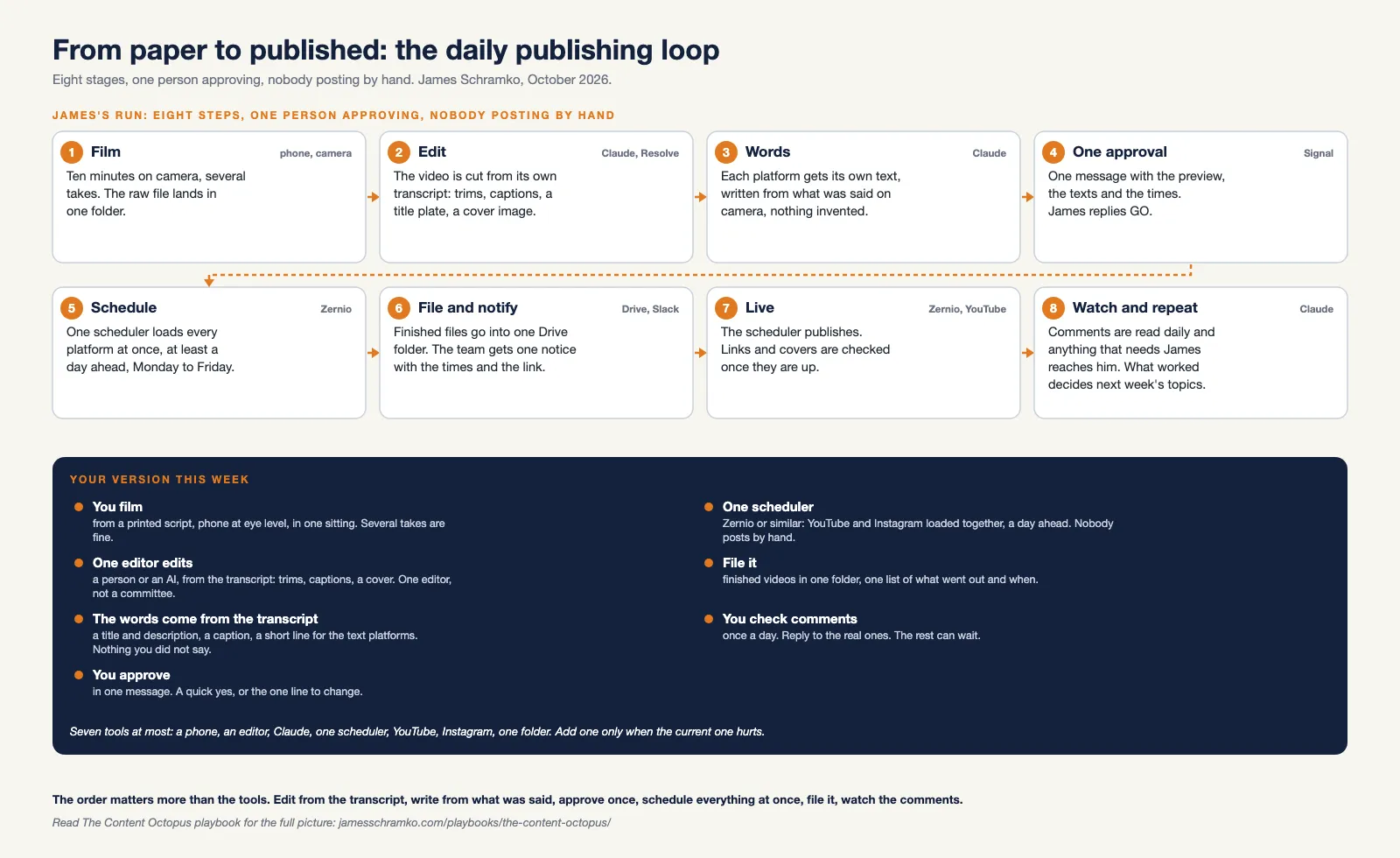
The Loop
One. Film from paper. Each morning a one-page slip comes out of the printer. A topic at the top, the first line to say, one example, three points, and a time: about 35 seconds, one take. Under that, two ways to shoot it, each with a line for the screen, a line for the cover, three opening lines to pick from and a shot list. I pick up the page, pick up the phone, and film one take. Usually. What passes to the next stage is one video file and the slip number.
Two. Edit from the transcript. The take gets transcribed. The cut is set from the words, against the slip. The sip of coffee stays, the "uh" goes. Captions come from the transcript. The tools are DaVinci Resolve, driven by Claude. What passes is a finished short of 40 to 50 seconds, a cover image and the transcript.
Three. Write every platform's words from what was said. One text for Instagram, Facebook and YouTube. A shorter one for X. One for LinkedIn that opens differently and ends on a question. A title and tags for YouTube. Every sentence comes from the transcript. If I did not say it on camera, it does not go in the caption. Claude writes these. What passes is a small set of text files and the video.
Four. One approval message. Everything lands in one message: the video, the cover, the title, each platform's text, where it goes and when. I read it once and say yes, or name the fix. A fix means a new message. One yes signs the lot.
Five. One scheduler loads every platform. Something like Zernio takes the video and each platform's words and books the posts. Go-live is at least a day out, weekdays only. Two pieces approved in one sitting go live a day apart. I never open an app to post.
Six. File it and tell the team once. The finished package goes into a dated folder on Google Drive. One message goes to the team channel on Slack: the piece, the platforms, the go-live times and a link to the folder. The team checks each post before it goes live and after, and puts any edit request in a second channel. The system makes the edit.
Seven. Live and checked. At go-live the posts publish. After that, the system checks each one is up and the words match what I approved. The live links are written back into the piece's folder. I hear about it only if something is wrong.
Eight. Watch the comments and let the numbers pick next week. Comments get answered. Every few days the numbers come in: views, reach, likes and comments, per post. A post that does ten times the usual tells me what to say more about. Next week's page comes from that, and from what the people I work with asked about this fortnight.
One Real Run
The slip came out of the printer at 7:30 on the morning of 14 October. Nobody Paid $799. Topic: pricing. The week before, five people in my group had a price decision on the table. One had held price against a big customer for the third week. One was charging less than a rival. One had been asked for a discount.
I filmed one take on the phone, 144 seconds, phone mic, well over the 35 seconds on the page. I did not say it the way the slip said it. That is fine. The slip gets me talking. The transcript is what gets edited.
The edit came out at 46 seconds. It opens on a sip of coffee. The price going up is held back as the reveal, and the Mercedes-Benz line follows it. On screen: NOBODY BOUGHT IT AT $799. Cover: NOBODY PAID $799. Title: Nobody Paid $799, So I Did This...
Platform words. Instagram, Facebook and YouTube got the same text: the domain that sat at $799, the day it sold at $1,199, the Mercedes-Benz rule on discounts, and the close, "Same domain, $400 more, same week, different buyer." LinkedIn opened with the Mercedes-Benz line instead and ended by asking what the reader is about to discount. X and Threads got the story and two lines, 275 characters.
One approval message that evening. One yes. Zernio booked it. Live on 15 October at 6:40 pm Brisbane on Instagram, Facebook and YouTube, 6:54 on X and Threads, 7:08 on LinkedIn. One Slack message to the team with the folder link. One of the team asked in the thread whether the captions looked small. A question, not an edit request. Answered there. Posted as is.
The number, pulled on the morning of 16 October 2026: the Instagram reel had 2,796 views and reached 2,393 accounts, with 13 likes and 3 comments. One page and one take.
Your Version This Week
The tools matter less than the order. The smallest version a one-person business can run looks like this.
Paper. Write tomorrow's short on one page tonight. A question, the first line, one example, three points. Print it or write it by hand.
A phone. One take. Stop at 60 seconds.
One editor, or an AI. Transcribe the take. Cut from the transcript. Captions from the transcript. Resolve, CapCut, or whatever you have.
One package. The post text written from the transcript, a title, a cover image. Pick one platform to start and connect that account to your scheduler.
One approval. Look at the whole package once, in one place, and say yes. Once, instead of five times across five apps.
One scheduler. Zernio or any tool that posts from one place. Book it a day ahead. Weekdays.
One check. After the scheduled time, open the post. Is it up, are the words right, has anyone commented. Before you write the next page, read the comments and look at one number.
Leave out: a team, a folder structure, a team channel, a numbers report. Those arrive when you have ten pieces live and something to report.
What Not to Do
Post by hand. Every app you open is a chance to rewrite the caption, change your mind and post an hour late.
Write captions from memory. You will write what you meant to say. The viewer heard something else.
Approve five times. One approval, in one message, covers the whole piece. If you approve the video, then the caption, then the time, then the thumbnail, the loop has five places to stall.
Add a platform before the first one works. Get one platform running on schedule for a month. Then add the next. The scheduler makes adding cheap. Adding early makes checking expensive.
Build a system before the first ten pieces. The slip, the folder, the team message, the check: each one was added after something went wrong on a real piece. Ten pieces through the small loop above will show you which parts you need.
Quick Reference
- Film from paper: one page, one take, a phone.
- Edit from the transcript, never from memory.
- Write every platform's words from what was said on camera.
- One approval message covers video, words, where and when.
- One scheduler books every platform a day ahead, weekdays.
- File it in one folder and tell the team once.
- Live, then checked: up, matching, links recorded.
- Watch the comments and let the numbers pick next week's page.
The loop is the same for a one-person business and for mine. What goes on the page, and what the numbers mean when they come back, is the judgment part. That is the work I do with owners inside Mentor.